As soon as visitors to the museum are greeted, and only after they sign the book, they are given a brief history of the building and the land on which the museum is located. Many people are already aware that we are located in the former Tuttle Square School, a building that has seen many uses in its 104-year history; for many years it was a school, an ARP Hospital during World War II, school department annex and offices, and the headquarters for the Auburn District Nursing Association.
While the building was built in 1922, there has been a school on this site since the 1700s, when this part of town was Sutton. The one-room schoolhouse was known by several names, including the Center District School, School No. 1, and South Street School. The growing school population of the early-1900s warranted the replacement of the one-room schoolhouse with a two-room schoolhouse, and in 1920, the school was picked up from its foundation, moved to Coolidge Street and converted into a private home.
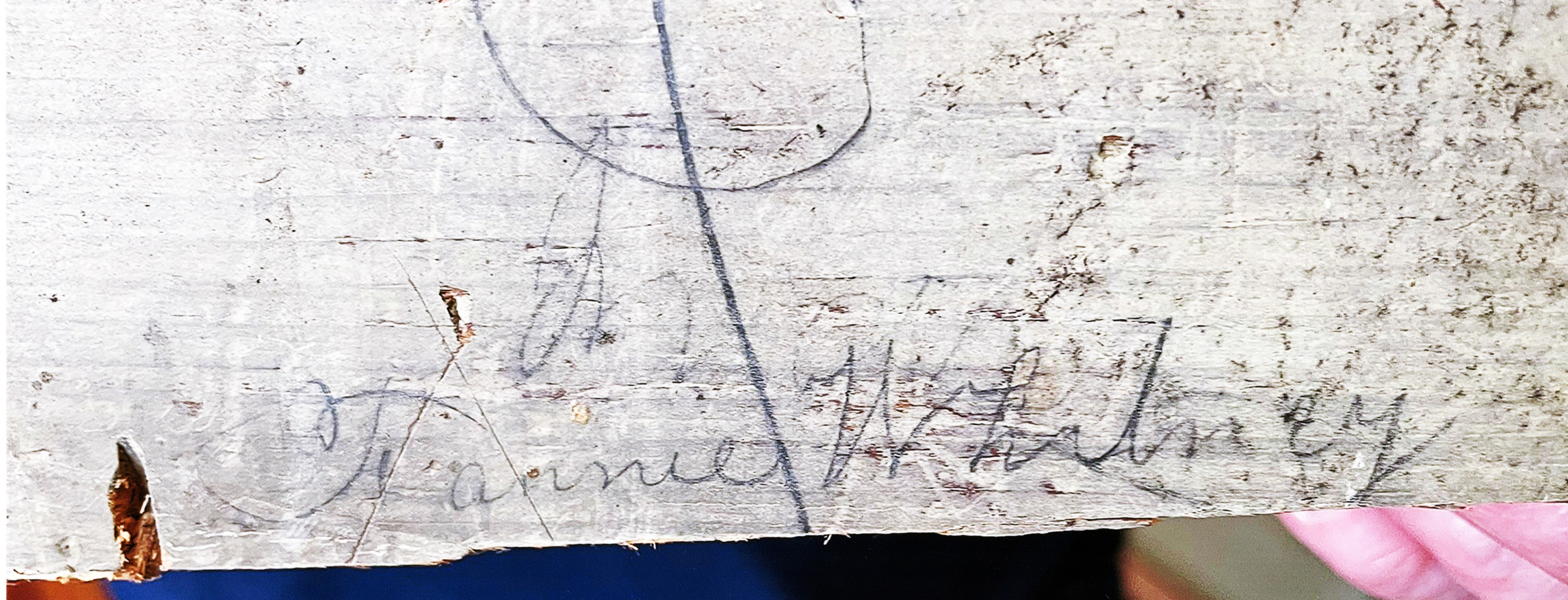
Earlier this year, we were contacted by the present owners of the old schoolhouse who are renovating it and asked us if we wanted to look around. Helen and Renee jumped at the opportunity and were able to see the original walls of the school. With the help of Wayne Bloomquist, the old wallboards that were destined for the dumpster were brought to the museum and are currently stored in one of our sheds.
Why would we want old wooden boards you might ask? Well, you’d be interested to know that kids have been little vandals for centuries! These boards (that still have hand forged nails in them) are covered in carved and written signatures, symbols, and even dates! We’re in the process of photographing the carvings, writings, and images, but one signature jumped out at us, and we decided to see what we could find. The undated pencil signature is that of Fannie Whitney.

Fannie L. Whitney, was born in Auburn on June 29, 1867, to David and Harriet L. (Howland) Whitney. Her father was a carpenter from Bolton, and her mother was from Lancaster. Through her mother, Fannie was related to the Howland’s of Worcester, a prominent family involved in printing and book making. Her first cousin once removed was Esther Howland, known as the “mother of the American valentine” because she was the first person to commercialize Valentine’s Day Cards in America in the mid-1800s.
Fannie grew up on Central Street, where her father David owned a significant amount of land and on June 8, 1891, she married Edward White at the First Congregational Church. Edward was a wire worker originally from Portsmouth, NH. The couple had two sons, Ralph and Philip. You may have heard of Ralph, also known as R. H. White. Fannie passed away on October 7, 1912 at the age of 45, and is buried in Hillside Cemetery.
We’re looking forward to examining the boards more to see who else left their mark!

